
Since 2022, the EU-funded CARINA project has been testing how two lesser-known oilseed crops could help diversify farming systems and create new opportunities for bio-based value chains. More than 400 demonstration plots across nine countries provided evidence of their potential under different farming conditions. At the project’s Final Conference in Brussels, researchers, farmers, industry representatives and policymakers discussed the results and what is needed to support wider uptake, from improved varieties and reliable markets to certification, investment and supportive policies. PEDAL Consulting, CARINA’s communication, dissemination and exploitation partner, was part of this journey and the final discussions.
Four years of testing new possibilities in the field
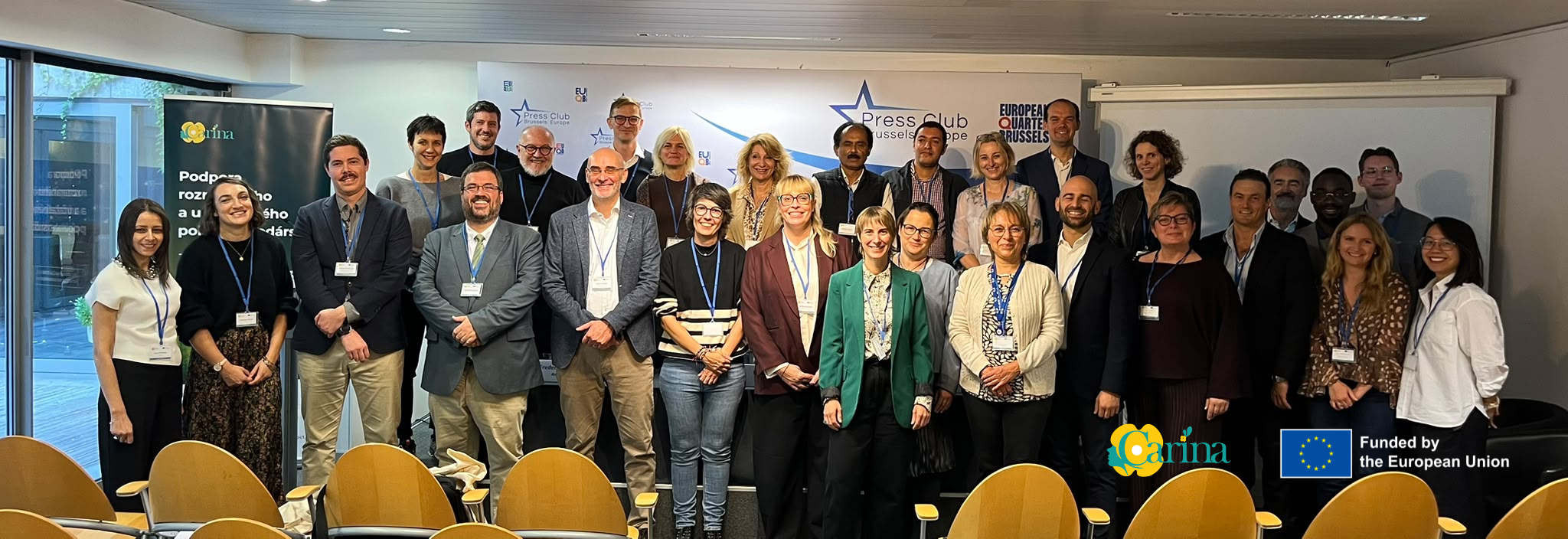
The CARINA Final Conference, held on 14 October 2026 at the Press Club Brussels Europe, provided an opportunity to present the main findings from the project and discuss what they could mean for the future of agriculture and the bioeconomy.
The conference was opened and moderated by Prof. Andrea Monti of the University of Bologna, CARINA’s project coordinator. Reflecting on the title of the event, “Unlocking the Potential of Carinata and Camelina in Europe and North Africa”, he noted, “Having potential is one thing, but turning it into a real opportunity for farmers, industry and other stakeholders is another story.” That question ran through the whole afternoon.
The field results were presented by Dr. Efi Alexopoulou of the Centre for Renewable Energy Sources and Saving (CRES). Since the beginning of its implementation in November 2022, CARINA partners have tested new cropping approaches across Europe and North Africa, including Serbia, Tunisia and Morocco. More than 400 demonstration fields and plots, covering over 500 hectares in total, explored how camelina and carinata can be integrated into different farming systems, including double cropping, intercropping and cultivation on marginal land. The trials were co-designed with farmers in local “lighthouses”, so that what was tested reflected real conditions on farms.
The results showed that the two crops can offer practical opportunities for diversification, but that successful cultivation depends strongly on local conditions. Winter camelina emerged as a particularly promising option, with its relatively short growing cycle and low input requirements allowing it to fit into different crop rotations.
Carinata, meanwhile, showed potential in selected environments, including the use of marginal and fallow land. Intercropping proved more demanding: it remains a promising starting point, but harvesting and separating two crops grown together still lacks suitable machinery. Experience also matters, as partners who had worked with camelina before achieved higher yields.
The project therefore points towards a more flexible approach to agricultural diversification rather than one solution that can be applied everywhere, different crops and cropping strategies need to be matched with local conditions.
Looking beyond the crop itself
The research did not stop at the field. As Marco Bernasconi of FLANAT Research showed in his presentation, CARINA also explored what can happen to the biomass after harvest and how different parts of the crop can contribute to a circular bioeconomy.
The project investigated opportunities for using oils, protein-rich meals and other biomass fractions in applications ranging from biofuels and animal feed to biomaterials, biostimulants, biopesticides and other bio-based products. Several of these reached an advanced stage.
Saipol processed both camelina and carinata seed on commercial crushing lines, producing oil and press cake fractions that were then used for feed, extraction and product-development work in the Work Package 2. Novamont used carinata oil to produce bio-based polyesters and a bioherbicide, demonstrated at pilot scale. KIMITEC used the oil and processing residues to develop biostimulants, biopesticides and bioherbicides, closing the loop by bringing parts of the crop back to the field as agricultural inputs. Camelina oil was used in a food product rich in omega-3 fatty acids that was tested in a nutritional study.
This value-chain perspective was also brought closer to farmers through visits to biorefineries in France, Italy and Spain. Farmers and cooperatives had the opportunity to see first-hand how oil from camelina and carinata can be processed and used, helping to connect agricultural production with potential markets further along the value chain.
The work highlighted an important point: the potential of a crop depends not only on how well it grows, but also on whether there are viable uses and markets for what is produced.
From research results to practical conditions for farmers
The second part of the conference moved from project results towards a broader question: what is needed for farmers to actually adopt these crops?
The roundtable “Enabling Farmer Uptake”, moderated by Pablo Fernández (Spanish Co-ops) featured Claude Soudé (COPA-COGECA), Luc Vernet (Farm Europe) and Frederic Moulin (AXEREAL), who shared their insights of growing camelina and carinata. The discussion highlighted that agronomic potential alone is not enough. Farmers need to see a clear economic opportunity, with reliable buyers, fair returns, practical technical support and manageable risks. A committed buyer, and ideally a minimum price, was described as a precondition for farmers to try a new crop.
Access to suitable inputs, knowledge and infrastructure also matters. For crops that are still less established than conventional oilseeds, uncertainty around markets and yields can make adoption more difficult. Summer heat and drought can limit yields of summer-sown crops, while small seeds, uneven ripening and the need for separate collection and storage add practical challenges.
The discussion reinforced the importance of cooperatives and producer organisations as links between farmers and emerging markets. Building these connections can help reduce uncertainty and make it easier for farmers to consider new crops as part of their existing production systems.
Industry needs a reliable supply chain
The industry perspective added another important part of the picture. The roundtable “Driving the Future Bioeconomy”, moderated by André Paula Santos of Nufarm, covered the whole value chain: Paloma León (Camelina Company), Christophe Beaunoir (FEDIOL), Marco Bernasconi (FLANAT Research) and Christophe Luguel (Bioeconomy for Change). The panel explored how demand for camelina and carinata-derived products could develop and what would be needed to move towards larger-scale commercial deployment.
For industry, opportunities exist in several markets, including biofuels, feed and other bio-based applications. Sustainable aviation fuel is creating demand today, but panellists stressed that it should not be the end of the story. These crops also produce protein meal, at a time when Europe still imports around half of the protein it consumes. Developing these markets requires more than promising laboratory results. Consistent biomass quality, sufficient volumes, processing capacity and reliable supply chains are essential for companies considering investment and commercial uptake.
The discussion also highlighted the role of stable policy and certification frameworks. Clear rules and credible sustainability requirements can help provide the confidence needed by both farmers and businesses when investing in new value chains. Speakers also pointed out that farmers’ income must be secured even in difficult years, for example through long-term contracts or crop insurance, as this summer’s drought left some camelina fields with almost no harvest.
This creates a clear connection between the different parts of the CARINA project: successful uptake requires agricultural systems that work for farmers, products that have a market, infrastructure that can process the biomass and policies that provide a supportive environment.
Certification and policy as part of the solution
Certification and regulation were another important theme of the conference, presented by Blanca de Ulibarri of the Roundtable on Sustainable Biomaterials (RSB). CARINA examined how existing frameworks, such as the Renewable Energy Directive and the new EU Carbon Removals and Carbon Farming Regulation, apply to emerging cropping systems and low-indirect-land-use-change feedstocks. The project identified nine gaps, finding that while sustainability objectives are largely aligned, terminology and evidence requirements remain fragmented. Harmonised definitions of intermediate crops and of marginal and degraded land were among the key recommendations.
For farmers, certification should be understandable and practical. For industry and markets, it needs to provide confidence that feedstocks meet recognised sustainability requirements.
The project’s work on policy therefore looked beyond individual regulations to the wider environment in which these new value chains need to develop. The message emerging from the project is that agricultural, energy, climate and bioeconomy policies need to work together if new sustainable feedstocks are to reach their full potential. Or, as the presentation concluded, land is not a constraint but an opportunity.
Different perspectives at the same table
One of the most valuable aspects of the Final Conference was the opportunity to hear these perspectives together.
Researchers presented evidence gathered through years of field trials and technical work. Farmers and agricultural organisations brought practical experience and highlighted the conditions that influence adoption. Industry representatives looked at markets, supply chains and investment, while the policy perspective addressed the frameworks needed to support the transition.
All these viewpoints made clear that the future of camelina and carinata cannot be shaped by research alone. Moving from demonstration to wider uptake requires coordination across the entire value chain.
A milestone for CARINA and a starting point for the future
For PEDAL Consulting, the Final Conference also marked an important milestone after four years of supporting CARINA’s communication, dissemination and exploitation activities. From communicating project results and engaging audiences around the project to supporting the visibility and future use of its outputs, we have worked alongside the consortium throughout the project’s implementation, and also organised the Final Conference in Brussels.
The conference offered a fitting opportunity to showcase this work: not only to look at what CARINA has learned, but also to discuss how those results can continue to be used.
CARINA officially concludes at the end of October 2026. Its field results, research publications, policy work and other resources will continue to provide knowledge for those working on agricultural diversification, renewable feedstocks and the wider bioeconomy. The full recording of the conference is available on YouTube.
For us, the conclusion of the project is therefore not simply the end of a four-year project cycle. It is an opportunity to help ensure that the knowledge generated through CARINA remains accessible and continues to inform discussions about the future of more diverse and sustainable agricultural and bio-based value chains.
