
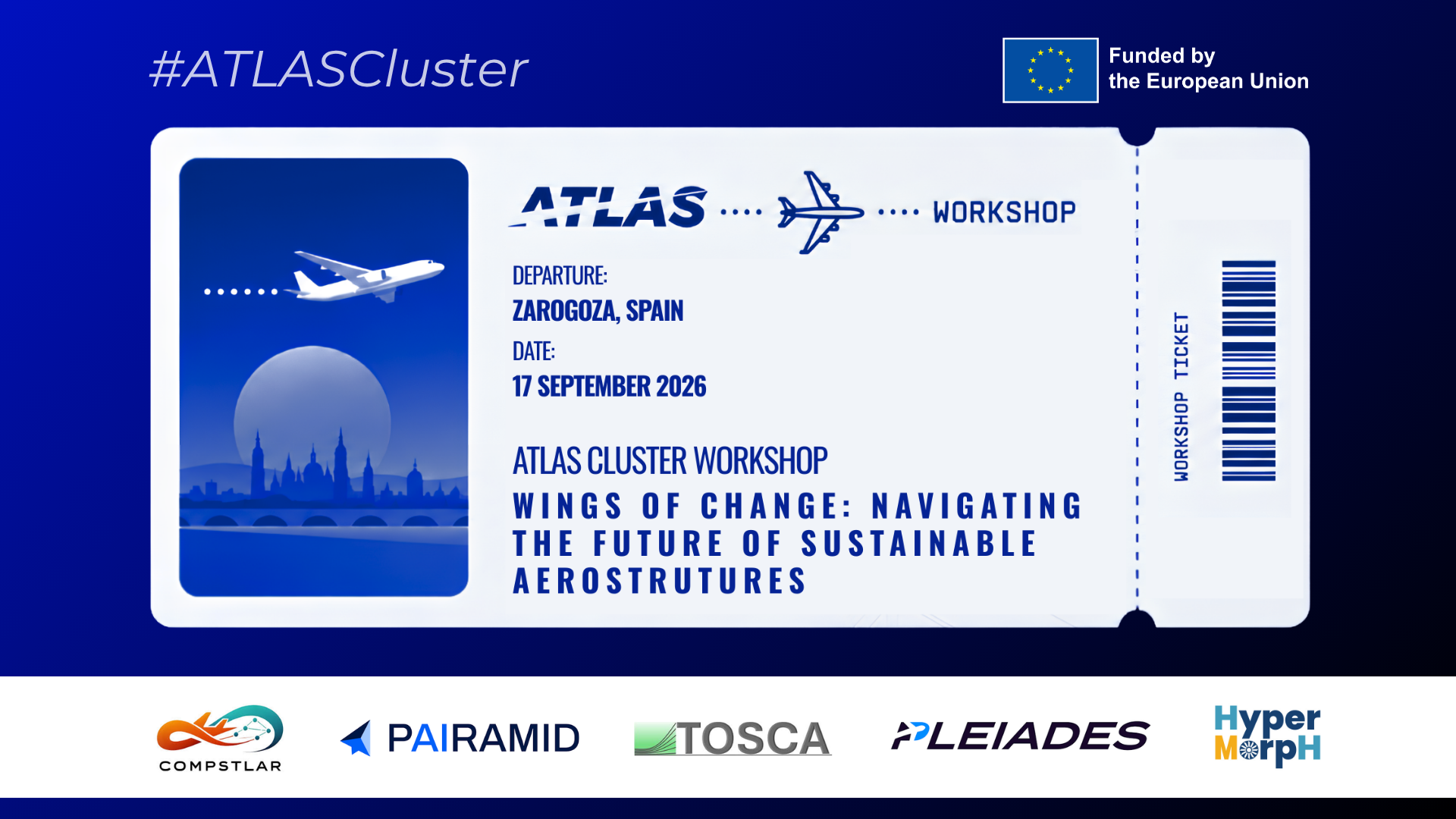
Recyclable composites, automated manufacturing, digital twins and artificial intelligence are changing the way future aircraft will be designed, produced and certified. On 17 September 2026, the first joint ATLAS Cluster workshop “Wings of Change: Navigating the Future of Sustainable Aerostructures” will offer a full day of expert talks, practical insights and discussion at the Aragon Institute of Technology in Zaragoza. Attendance is free, making it an ideal opportunity to explore emerging aviation technologies and connect with the people developing them.
Five projects shaping the next generation of aircraft
The ATLAS Cluster connects five Horizon Europe projects, CompSTLar, TOSCA, PLEIADES, pAIramid and HyperMorpH, working across the sustainable aerostructures value chain. Their research covers new recyclable materials, smarter production methods, digital engineering, virtual certification and advanced aircraft concepts. The workshop will show how these different areas fit into one wider vision for cleaner, lighter and more efficient European aviation.
Invited keynote speakers framing the day
The workshop is enriched by two external keynote speakers, invited from outside the ATLAS Cluster to bring a broader industry-wide perspective on the sector’s transformation:
Inés Villa Martínez, AERA Cluster Manager, Spain
As Manager of one of Spain‘s most influential aerospace innovation clusters, Inés brings a strategic industry view on the priorities, challenges and pathways shaping the future of European aerostructures.
Berta Gonzalvo, Research Director at AITIIP Technology Centre, Spain
Leading research at AITIIP, a reference centre in advanced materials and circular manufacturing, Berta pioneers work on enzymatic recycling as a pathway to truly circular aerospace composites.
From recyclable composites to circular aerospace materials
The first session will explore how advanced composite materials can become easier to repair, reshape, reuse and recycle without losing the performance:
Nerea Markaide, CIDETEC, Spain
Covalent adaptable networks improving the performance and circularity of composite materials.
Belén Redondo, GAIKER, Spain
Conductive, bio-based composites combining sustainability with demanding aerospace performance.
Rafal Kozera, NOMA Resins, Poland
Multicycle recycling and the possibility of giving composite materials several useful lives.
Marc Wilms, Fraunhofer IPT, Germany
Recovering valuable materials from composite laminates and returning them to production.
Can aircraft manufacturing become smarter and more automated?
The second session will focus on technologies that can make composite production faster, more precise and more reliable:
Pablo Romero Rodríguez, AIMEN, Spain
Automated fibre placement supporting the production of a new generation of tailored composite parts.
Christian Eitzinger, PROFACTOR, Austria
Machine vision, robotics and artificial intelligence detecting manufacturing defects more effectively.
Harry Zervos, ICCS-NTUA, Greece
Photonic and fibre-optic technologies for monitoring composite manufacturing processes.
Daniel Gomes, INEGI, Portugal
Continuous carbon-fibre 3D printing meeting the demanding requirements of aerospace production
Digital twins, AI and the future of aircraft certification
Digital technologies could significantly reduce the time and resources needed to test, maintain and certify new aircraft components. The third session will look at how virtual models and real-world data can support safer and faster decision-making in aerospace testing, maintenance and certification:
Carlos González, IMDEA Materials Institute, Spain
Digital twins and physics-informed artificial intelligence improving the prediction of composite behaviour.
Sabrina Verardi, Engineering Ingegneria Informatica, Italy
A digital thread connecting data across the composite manufacturing value chain.
Andrea Calvo-Echenique, Aragon Institute of Technology, Spain
Physics-based simulations and data analysis supporting predictive maintenance and extending the life of composite structures.
Julen Manterola, IKERLAN, Spain
Multiscale reliability models and virtual testing speeding up aerospace certification.
Turning research results into real aerospace impact
The final thematic session will look beyond individual technologies and consider how European research can move closer to industrial use:
Cinzia Rubattino, Engineering Ingegneria Informatica, Italy, and Cláudio Santos, INEGI, Portugal
A roadmap for future aerospace innovation, highlighting shared priorities, opportunities and challenges across the ATLAS Cluster projects.
The discussion will also address technology roadmapping, intellectual property, cooperation with industry and the steps needed to turn promising research into practical aerospace solutions.
For the complete programme, presentation times and speaker details, download the separate event agenda.
HyperMorpH and PEDAL Consulting at the workshop
The HyperMorpH project is developing an advanced aircraft concept combining hydrogen-powered propulsion, composite structures, hyperconducting technologies and intelligent morphing solutions.
During the closing panel, our Project Managers Stania Druskova and Simona Baldovska will guide the discussion on how innovations developed across the five projects could work together within future aircraft.
The panel will reflect on the main lessons from the day and explore what still needs to happen before these technologies can move from individual research projects towards practical aviation applications.
Who is the event for?
The workshop is particularly relevant for professionals working in aerospace, advanced materials, manufacturing, digital engineering, aircraft design, certification and innovation management.
It will also be valuable for researchers, students, policymakers and anyone interested in how new technologies could make aviation more sustainable.
Join the event in Zaragoza or online
The workshop will take place on 17 September 2026, from 09:00 to 17:00 CEST, at the Aragon Institute of Technology in Zaragoza, Spain.
Participants are encouraged to attend in person to benefit fully from the discussions and networking opportunities, but an online option is available for those unable to travel. Participation is free of charge, although registration is required.
Registration:
In-person attendance closes on 7 September 2026.
Online participants can register until 15 September 2026.
Register here.
Explore the technologies shaping the next generation of European aircraft and hear directly from the researchers and innovators working to make aviation lighter, smarter and more sustainable.
