

The aim of the first finance innovation roundtable was to create a platform for discussions and dialogue to be held between public institutions and the private sector. The wider goal of the initiative is to support the sustainable development of financial innovation and increase cooperation across sectors.
In its first meeting, the group fixed principles for operation, setting goals for the upcoming year, and identified topics of interest such as digital currency, cross-border transactions, and payment systems, cyber security, crypto currency, big data, and challenger bank platforms.
Initiated by the Estonian Bank, the roundtable of finance innovation was gathered for the first time in Estonia this February. The working group includes the Financial Inspection, the Ministry of Finance, the Ministry of Economic Affairs and Communications, FinanceEstonia, Enterprise Estonia and KredEx. The private sector is represented by FinanceEstonia whose board member Henri Laupmaa (founder of Fundwise) is a proud Advisory Board member of Altfinator.
More information about their activities can be found a financeestonia.eu.

Conclusions from ALTFINATOR 5th WEBINAR – “How to use reward-based crowdfunding for financing innovative SMEs”
The webinar counted with two experienced speakers who represented the supply and demand side of this financing instrument: the reward-based crowdfunding platform provider “Verkami” and the SME “Cocoro” that has successfully raised reward crowdfunding.
Verkami is a leading reward crowdfunding platform in Spain and one of the three largest reward-based platforms at European level. Since its beginning, Verkami has successfully financed more than 7.900 business projects and raised more than 40 million euros, thanks to a network of more than 1.1 million contributors. Jonàs Sala is a Doctor of Computational and Applied Physics and co-founder of the reward-based crowdfunding platform Verkami which began to operate in the year 2010. He trains on crowdfunding issues as a lecturer for several university masters. Mr. Sala presented what are the benefits for SMEs of this type of finance, what might be the risks and how they are mitigated, and how it works in practice.
Cocoro is a company that designs and produces menstrual panties in Barcelona. It all started in 2016, with a crowdfunding campaign using the Verkami platform, which was a total success and definitely the first milestone of a project that hasn’t stopped growing. Ms. Clara Guasch is co-director of Cocorointim SL and Chief Communications Officer. She is also one of the four co-founders of the company. Ms. Guasch told its successful experience in raising finance through reward crowdfunding, why they decided to use this financing instrument, how they got to succeed in the finance raising campaign, and what should be considered by SMEs when raising this type of finance.
After an initial introduction on Altfinator project by Alberto Sierra from Zabala Innovation Consulting (as moderator of the webinar), each speaker made a 20 minutes presentation. The webinar ended with 10 minutes for a ‘questions & answers’ session.
Main topics discussed:
Jonàs Sala covered:
Benefits for SMEs of this type of finance;
Potential risks and how to mitigate them;
How a reward crowdfunding platform works in practice.
Clara Guasch described:
Why they decided to use this financing instrument;
Her successful experience in raising finance through reward crowdfunding;
What should be considered by SMEs when raising this type of finance.
Main conclusions:
Reward-based crowdfunding involves individuals contributing comparatively small amounts of money to business projects in return for some kind of reward, which often is a production version of the crowdfunded product, which is offered to contributors under more favourable conditions than general market conditions.
A reward fund-raising campaign lasts around 40 days. When it ends, there are two possible scenarios: either the business promoter has got the targeted funding and gets the money from backers/contributors that enables to finance the production, distribution and reward them with the new product, and the platform charges a 5% commission fee to the entrepreneur, or alternatively the targeted funding is not reached, then the money is given back to contributors, there are no costs for producing or rewarding, and the platform does not charge any commission fee. In other words, the crowdfunding raising campaign has almost no financial risk for the business promoter.
With a few backers, the business promoter can produce more units than with his/her own resources only. Once you finish your campaign, all cost are already covered and the risk is considerably reduced compared to a bank loan where a business promoter may be in trouble if he/she gets a bank loan, invest the loan in producing the new products and finally they are not sold and therefore find himself/herself in trouble to pay-off the bank loan. Such risk does not exist in a reward fund raising campaign where production is not started until the funding target has not been reached.
Reward crowdfunding helps business projects not only to raise finance but to test market acceptance before launching new products and it is a powerful marketing tool that is being progressively used by small and large firms too. It helps to validate the business idea, get feedback from end-users on the product (price adequacy, preferences on design/features, models, etc.), it leverages product recommendation and builds a community of “ambassadors” and investors for future fund-raising campaigns.
Verkami works closely with business promoters and offers its expertise along with the raising fund campaigns. As a result, so far more than 75% of campaigns published in its platform have reached their finance target and got funded. That is one of the highest success rates in comparison to other reward-based crowdfunding platforms. The managers of this platform advise and help each and every promoter to set a good target funding, a good reward scheme, and a good communication campaign design and planning.
Therefore, what are the key factors for a successful reward fundraising campaign?
Estimate the right budget or crowdfunding target for your project, including the minimum number of units you need to produce and “pre-sell” (reward in exchange of a fixed contribution amount) in order to cover production costs, shipment costs for delivering the reward to your backers, platform and VISA credit card/payment platforms commissions that will be charged, VAT taxes, etc.
Offer an attractive reward, at a better price than it will be sold in shops. Scale or define different levels of rewards according to different fixed options of amounts/contributions (for instance, offer just the product for the minimum fixed contribution option, the product with a supplement kit for a fixed medium contribution option, or several models/colours, or both the product and the kit and also free shipping for the highest option of a fixed amount -contribution).
Set a very good description into your campaign, including good pictures, a good explanation about the features of your product, and about the entrepreneurial team who is behind the project. Explain the planned timetable to produce the products and when the contributors/backers will receive the reward/product.
Communicate the campaign in all possible channels: social networks, podcasts, contacting co-working spaces, influencers, blogs, press, radio, etc. Approximately 2% to 3% of Facebook/Twitter/Instagram visits to the campaign use to convert into contributions.
Plan well in advance the communication campaign: what you will do in each and every one of the 40 days of the campaign duration. And of course, implement and devote yourself proactively to it; it will be quite time-consuming. Success during the first days is crucial.
The SME representative explained that when they started their business in 2016 and wanted to move from the idea/prototype to a production scale, they explored three financing options:
Bank: a guarantee was required; they didn’t have money for that guarantee, and they should give back the loan with a high-interest rate. They ruled out the bank option.
Investors: either money had to be given back with interests, or investor asked to be partly owners of the company (part of the company needed to be sold to investors). They also ruled out the investors’ option.
Reward-based crowdfunding: Many people spending small amounts of money and allowing the business promoter to pre-sell its product with very reduced risk. This was their option.
In the opinion of the SME, the reward fund-raising campaign requires specialized knowledge, time and money (for photos, video, social ads, prototypes for influencers, promotion, etc.). In fact, they had to ask for a loan to cover these campaign costs.
Cocoro’s campaign was a great success. They had planned a goal of a minimum production of 1.500 panties in order to start an e-commerce site, for which they needed 21.560 € and approximately 700 backers. They finally got to raise 169.625€ and produced 9.000 panties (6.700 sold) with 3.433 backers and 6 million people of audience reached.
For the SME it was very important to plan what to do BEFORE launching the campaign. This meant to select an adequate platform (they were focussed on a national audience, so they went to a platform operating at national scale), set the right funding target/goal (minimum budget to start production), select the reward (what is it we want to validate? What will our backers want?) and set the basics for the communication campaign (goals, key messages, identity, audience, channels, actions, and materials needed).
The business promoter must also be prepared for an unexpected success of the fund-raising campaign, i.e. be aware of what will be the consequences of each funding milestone if reached and analyse if the current plan of action will still be valid (e.g. will the promoter be ready for a bigger production?) That was the case of Cocoro, the success exceeded its initial production capacity and they had to look for other places to produce the product and for additional logistics to distribute the product/reward. They also rescheduled and communicated a new timing to its bakers’ community, asking them to wait a little bit more for receiving the reward (the backers used to be understandable to this type of delay warnings).
In a later company growing and expansion phase, the previous reward-based crowdfunding campaign can be supplemented by an equity crowdfunding campaign taking advantage of the community of contributors that already supported the business project at its early stage. That was again the case of Cocoro who after its experience with the reward-based campaign knew that they had a community that felt part of the business project, and they wanted to keep the project as open as possible (i.e. to avoid a single investor) and keep running the business on their own way. They also realised that, if they wanted to grow internationally, they needed to start having an international community: that is why they selected an international equity crowdfunding platform like Crowdcube for that equity raising crowdfunding campaign, which also was a big success. They got 300.000 € of equity investment which was equivalent to 134% of its initial fund-raising target.
They also reached one of the highest percentages of female investors in the Crowdcube platform (38% of investors in its campaign were women). They consider that women are more prone to invest through crowd-equity, than through more traditional means. According to the Verkami platform experience, approximately 30% of business promoters who have run a reward-based fund-raising campaign use to grow its community of backers around its business project by making a successive or second reward-based campaign. This second fund-raising campaign uses to be easier since you already have built a community of contributors on which you can rely. Yet, such a second campaign must be focused on a different -although related- project than the first one. If the second campaign focuses on the same initial product, then experience shows that it is better to go for an equity crowdfunding campaign than to repeat a reward-based campaign.
Watch the recording of the webinar HERE.

THE RESOURCES AND TOOLS YOU SHOULD KNOW ABOUT WHEN DEALING WITH ALTERNATIVE FINANCE
The interactive web documentary integrates learning materials, resources, and tools produced for specific topics related to alternative financing, aiming to provide insightful and useful know-how for key players acting in the financing ecosystem, from SMEs and entrepreneurs to financing providers, finance consultants and policy makers.
The viewer will be able:
To find the alternative financing provider that better suits their financing needs in our matchmaking tool;
To learn which type of alternative finance fits the different entrepreneurial stages;
To know more about the characteristics from best-performing countries on alternative finance;
To learn the success factors that could influence the emergence of alternative financing;
To access to the SWOT analysis of Alternative Finance in 8 countries;
To check the regulatory framework on alternative finance in 8 EU countries;
To read the vision outlook on FinTech;
To access to more success stories of SMEs using alternative financing.
Every asset showed in the web documentary can be directly accessed through a link and at the end of the web documentary the viewer can also leave us their comments and opinions on the subjects presented in the video.
If we have triggered your curiosity with this, wait no more and check the web documentary now.
PLAY

ALTFINATOR NEWSLETTER ISSUE NO 4
This issue of the Newsletter has as featuring article the white paper on alternative finance developed by the project, under the title “golden rules on alternative finance”. In addition, this issue also includes the impact analysis of our events, our strategy for ensuring the project’s legacy through the creation of the national hubs, the successful performance of the 2nd edition of the MOOCs, and our way to showcase all the resources developed by the project in our interactive web documentary.
The Newsletter also provides to our readers, first-hand information about our upcoming events, the key conclusions from past events and interesting developments at the national level on alternative finance from countries such as Estonia, Spain, and Ukraine.
Enjoy the reading!
Access to the newsletter HERE

EUROPEAN PARLIAMENT WORKING BREAKFAST
Altfinator Parliament working breakfast has been postponed until further notice due to the Covid-19.
The event was planned to be hosted by MEP Caroline Nagtegaal, a member of the EP Committee on Economic and Monetary Affairs and EP rapporteur responsible for a file on “Markets in financial instruments: crowdfunding service providers”.
Innovative SMEs and start-ups access to Alternative Finance (AF) instruments are being promoted by the European Commission throughout last years, and regulatory developments at the EU level on alternative finance, and particularly on crowdfunding, have been worked on at the European Parliament.
During the breakfast, attendees will have the opportunity to know first-hand the added value of the new European Crowdfunding regulation for the crowdfunding industry in Europe, the recent AF market developments and trends in the European Union, and recommendations from the Altfinator project to increase AF capacity in Europe.
Attendance will include Members of the European Parliament, representatives from the European Commission services, representatives from the Crowdfunding industry and multipliers (industry associations for SMEs; SME support organisations, information intermediaries-start-up hubs, accelerators, incubators-, business advisors, etc.), and Altfinator consortium members.
MEP Caroline Nagtegaal, Oliver Gajda (CEO, European Crowdfunding Network) and Gabor Vicze (Innomine) will present the initiatives conducted at the EP to boost a European crowdfunding ecosystem, its market development, and trends, and the Altfinator white paper conclusions to further stimulate AF capacity in Europe.
The breakfast will end with an open debate among participants moderated by Ronald Kleverlaan (Director, Crowdfundinghub).

ALTFINATOR HUBS: CONNECTING EUROPE ON ALTERNATIVE FINANCE
To support the local alternative finance ecosystem in countries, Altfinator has developed the Altfinator Hub model. Already in several countries in Europe, local partners have adopted the Altfinator Hub in their own country. These partners are startup/SMEs support networks that are able to distribute and translate the training materials from Altfinator and adapt them to the local cultural situation.
The Hubs facilitate webinars and workshops, provide open-access tools and training materials and facilitate the collaboration between banks, startups and SME associations, policy makers and regulatory agencies to stimulate the alternative finance network in each country.
The individual national Hubs are working together in a European network of hubs, sharing best practices on building and supporting an alternative finance ecosystem and share their insights through peer-learning.
At this moment we have partners and national Altfinator Hubs in Slovakia, Lithuania, and The Netherlands, and we are negotiation with organisations from Estonia, Hungary, Spain, and Portugal.
For the case of Slovakian Hub, we are pleased to announce that BIC Bratislava (Business & Innovation Centre) agreed to undertake the role of the Altfinator Hub in Slovakia. The organisation currently acts also in the following capacities:
Coordinator of the Enterprise Europe Network representation in Slovakia
SME NCP – National Contact Point: Horizon 2020 “Innovation in SMEs”
Access to Finance NCP – National Contact Point: Horizon 2020 “Access to risk finance”
Since 1991, when the Business and Innovation Centre Bratislava was founded, the activities have focused primarily on supporting innovation, technology transfer and business development. Its services include business and innovation advice, support international cooperation, consultation within access to finance, as well as support for the EU framework programmes for research, development, and innovation as well as in the field of protecting intellectual property or finding potential business partners. Most of the activities are focused on SMEs with innovative potential and on developing their products or technologies.
“We are very much interested in and benefit from carrying on promoting alternative finance opportunities with the support of the materials, networks and event methodologies introduced with Altfinator. We are in daily contact with companies searching for innovation funding. It will help us to further improve the access of innovative SMEs to alternative forms of financing”, said Ivan Filus, the Senior Consultant at BIC Bratislava who is also the Advisory Board Member of the project.
If you know any organisations that may be also interested in becoming a national partner? Let them know they can contact the Altfinator coordinator through info@altfinator.eu.
For more information about national Altfinator Hubs, check https://www.altfinator.eu/hubs

FinanceEstonia awards credit providers with Best Practice 2020 certificates
The Best Practice initiative and certificates were created by credit providers and intermediaries collectively in order to enhance and emphasize the relevance of good practices and business ethics in the sector. The process of giving out certificates and approving applications is organized by a dedicated commission called to live at FinanceEstonia.
“Different from the crowdfunding sector, credit providers and intermediaries are highly regulated and inspected. By being transparent and participative while following the existing requirements, credit providers can help to improve the reputation and trustworthiness of the sector,” says Katri Tomson, Senior Associate at Law Firm TRINITI and the current leader of the Best Practice Commission.
Following (or not following) the principles needs to be presented at the credit providers’ websites. To acquire the certificate, the applicant needs to submit a report to the Best Practice Commission where the credit provider is asked to explain how they uptake the Best Practice principles as well as what they plan for the future.
FinanceEstonia is a public-private cluster initiative with the aim of establishing Estonia as a vibrant and innovative location for financial services. Their membership is open to corporates, financial institutions and professional advisors wishing to use Estonia as a base for domestic and international business.
The best practice developed for creditors and credit intermediaries can be found in English at financeestonia.eu HERE.

2nd edition of the MOOC on alternative finance achieved 400 subscribers!
The 2nd edition of the MOOC (Massive Online Open Course) on Alternative Finance, which could be accessed absolutely free of charge here has achieved huge success with nearly 400 subscribers.
The course introduces the key models and approaches related to raising finance from sources alternative to bank lending (crowdfunding, invoice trading, venture capital, business angels, fintech platforms), addressing these topics both at a basic and advanced level.
The course counted on the participation of providers of alternative finance and professional investors as well as entrepreneurs, startuppers and policymakers, who wanted to learn more on these new financing channels available for startups and SMEs.
More than 80% of the participants came from Southern and Eastern European countries, such as Italy, Lithuania, Spain, and Ukraine, where the market of Alternative Finance still needs the transfer and adopt best practices for further growth. This was one of the specific objectives of this second edition, which we were able to reach. Moreover, female participation reached nearly 40%, which could be considered an excellent result given the low incidence of female professionals in the target audience of the MOOC.

Curve bringing Samsung Pay to all banks through novel workaround
Samsung’s mobile wallet Samsung Pay has, until now, struggled with moderate support from the UK’s high street banks, with only HSBC, The Coop, Nationwide and Santander signed up… until now.
Curve, the all-in-one bank card, fresh off its edgy rebrand, announced this morning that it was adding support for its card to be added to Samsung Pay.
What this means is that, indirectly, all the Visa and Mastercards supported by Curvecan now be used through Samsung Pay.
“It’s fantastic that Samsung customers will be able to take advantage of all the features of Curve, and we are happy to invite customers of more banks to the Samsung platform,” said Diego Rivas, Curve’s Head of Product
It’s a curious implementation of Curve’s technology, putting banks with no direct relationship with Samsung in the position of supporting Samsung Pay, reminiscent of Curve’s forays with American Express over the years.
Samsung Pay users who take advantage of Curve’s offering to add, say their ‘officially’ unsupported Halifax or Barclayscard to Samsung Pay, will also take advantage of Curve’s existing feature-set—1% instant CurveCash at certain retailers, Go-Back-In-Time to switch card payments, and cheap FX rates.
Curvealso said this morning that the launch was a key part of its roadmap as it gears up to scale “throughout Europe and into the US in 2020”.
In July Curveclosed a $55m Series B funding round at a $250m valuation, and in September Curvebroke its crowdfunding target by raising £6m in an oversubscribed Crowdcubecampaign.
This story is brought to you courtesy of the Altfinator Project in which Pedal is a partner.

RRI’S PRACTICAL IMPLEMENTATION IN NORWAY GIVES POINTERS FOR FURTHER RRI ADOPTION
Responsible Research and Innovation (RRI) aims to foster intimate linkages between science, technology and innovation to address the so-called grand societal challenges. These include health, food security, clean energy, sustainable transport, climate change, inclusive societies, freedom and security of Europe and its citizens. RRI has a role to play in ensuring the intricate entanglements of “science and society” in the making.
RRI invites us to deliberate fundamental questions related to what kind of futures we want science, technology and innovation to bring into the world. The Norwegian experience of integrating RRI in some of the major national research funding programmes indicates the importance of changing current research and institutional practices to ensure a societally responsible weaving of the research and innovation fabric.
The challenge of addressing Grand Challenges, as explored in a 2014 report by Stefan Kuhlmann and Arie Rip for ERIAB, reviewed current approaches, structures and practices in relation to tackling these grand challenges. It argues that the grand challenges not solely resides “out there” in society for the science, technology and innovation community to “address.” This indicates that we should not simply take research and innovation as a means to address societal challenges. Instead, we should invert this approach and make research and innovation an object of inquiry in its own right.
Following this evolution of our thinking, we might consider RRI as a wake-up call to a reality where science, technology and innovation are always already embedded in society and vice versa. As such, RRI invites a new attempt to mitigate the asymmetry that Jerry Ravetz articulated as follows in 1975: “Science takes credit for penicillin, while Society takes the blame for the Bomb.”
Responsible Research and Innovation experiments
I have closely followed RRI experiments and I strongly value related discussions at the Research Council of Norway (RCN). In this context, solving the grand societal challenges implies examining the research and innovation system itself.
This approach requires developing competencies and skills and creating suitable diagnostic and prospective capacities. Because basic understandings and diagnoses frame the issues at stake in solving grand challenges, they need to be made more explicit. They also need to have been discussed as an integral part of research, innovation as well as policy-making.
Currently, developing skills and capacities regarding what is referred to as “second-order reflexivity” tops RCN’s RRI agenda. This requirement was already clearly outlined in the 2009 expert-report by the European Commission entitled Challenging Futures of Science in Society. Reflexivity requires what the report calls “further skills” as researchers, as well as policy-makers, must enhance their ability to provide meta-knowledge “about premises, conditions of validity, uncertainties, areas of ignorance, values and conditions of applicability to certain contexts” in research and innovation.
The RRI framework of the Research Council of Norway thus support the development of skills that are required to open up the research and innovation processes. And to recognise the limits of our own knowledge and competence. It also supports the involvement of stakeholders and various publics to help in dealing with the potential effects of research and innovation processes.
Governance of complexity
The new strategy of the Research Council of Norway, entitled Research for Innovation and Sustainability 2015–2020, is geared towards greater societal responsibility than before. It focuses on research and innovation activities that are likely to yield benefits for society at large in the long term. It also foster solutions that help in addressing the societal grand challenges.
The RRI framework was developed in parallel with the main strategy by the large scale technology programmes; namely the Research Programme on Biotechnology for Innovation (BIOTEK2021), the Research Programme on Nanotechnology and Advanced Materials (NANO2021), the Initiative for ICT and digital innovation (IKTPLUSS) and the Programme on Responsible Innovation and Corporate Social Responsibility (SAMANSVAR).
The framework was inspired by international developments; in particular, the emerging RRI policy by the Engineering and Physical Sciences Research Council (EPSRC) in the UK. The RCN programmes conducted several RRI experiments while building their RRI ambitions. These stretch goals were later set down in the RRI framework. They not only formulate expectations for the research organisations receiving funding but also for the programmes themselves, as responsible societal actors.
Governance in complexity
The large scale technology programmes driving RCN’s RRI-engagement, did not happen by chance. Indeed, research, technology development and innovation entail more than uncovering truth or charting out new and improved maps. These are activities that can, potentially–and often directly–change the landscape in which we live. We are not merely “reading” nature. Increasingly, we are “rewriting” it as well, as Jack Stilgoe explains in his 2015 book Experiment Earth.
RCN’s RRI framework designates a key role to governance, as does many other framings of RRI that have emerged in recent years. At the same time, the understanding of governance changes as a result of the distribution of responsibility for governance in dynamic and heterogeneous networks. Governance in complexity seems a wiser strategy than attempt at governance of complexity.
Here, the framework points to resources that emerge from the work on Constructive Technology Assessment (CTA) in the Netherlands, including ‘responsible development’ and ‘transition management “”)’, as well as the 2015 European Commission expert report on RRI indicators for promoting and monitoring Responsible Research and Innovation.
Out of our comfort zone
Today, we are pursuing our RRI experiments in tandem with Digital Life Norway, among others. Ongoing discussions point to question whether we need a version 2.0 of the RRI framework.
This new version would include a new dimension of the RRI approach, called “transition.” It is based on bringing together multiple perspectives and multiple experimental approaches to make the RRI transition sustainable. This notion would be included to the key aspects included in version 1.0 already covering ‘anticipatory’, ‘reflexive’, ‘inclusive’ and ‘responsive’ research and innovation processes. Our collaboration with the newly formed Transformative Innovation Policy Consortium (TIPC) provides the background and motivation to include the dimension of “transition” towards RRI.
RCN’s experiments indicate that RRI is not respecting the traditional boundaries between research, innovation and politics. In discussions amongst researchers following Brexit, we have heard calls for more RRI activism. Some find it rather unsettling, individually–they feel this new order threatens their professional identities. From an institutional perspective, RRI entails not respecting the established divisions of labour.
To others, the RRI wake-up call rings so loud that it even disturbs our received notion of excellence in research. The 2014 Rome Declaration on Responsible Research and Innovation in Europe, gave a revised definition of what excellence in research means through the lenses of RRI: “excellence today is about more than ground-breaking discoveries, it includes openness, responsibility and the co-production of knowledge.”
This suggests a change of direction from ‘outreach’–working to convince the public about the value of research and innovation– towards ‘inreach‘–presenting expectations about learning and development to ourselves and to the peers in the research and innovation communities. Some of us are, by now, far outside of our comfort zone.
This article is brought to you courtesy of the HubIT project in which Pedal Consulting is a partner.

WORKING FOR AN INCLUSIVE FUTURE AT HUBIT BRATISLAVA DESIGNATHON
The event took place between 25-27 of November 2019 in Bratislava, Slovakia
The event was attended by 35 competing participants who were divided into 8 working teams (made up of 4 – 5 members each), coming both from the ICT and SSH, well mixed in each working group, while they worked on projects and/or products related to inclusiveness in one of the 4 proposed areas: 1. better access to education / online learning for disadvantaged groups; 2. solving daily hurdles faced by the migrants or victims of human trafficking in the hosting country; 3. combatting fake news, hoaxes, ‘deep fake’ and spreading of disinformation; 4. internet, machine learning or artificial intelligence: “How to ensure that humans will have the last say?”.
Every team was couched, and their products/projects evaluated by experts and judges, coming mostly from ICT vs. SSH and/or business sector. The jury members received a preparation kit to be followed before the event took place. There were four winning teams designated by the jury, receiving an opportunity to take part in a traineeship at LOBA, get professional support and consultancy in scope of Tenderio project, Qualification for the HubIT Common Ground Camp, and a special laptop bag made of waste material following the concept “waste-to-best”.
Participants were very active during the 2-days Designathon aiming for development of their inclusive products/projects. Organizing staff prepared a social event for the first evening of the Designathon and icebreaker sessions to make people more comfortable and know each other better for the purposes of smooth teamwork. The participants were provided a quite exhaustive introduction to the project, concept of RRI and also to the methodology of the Designathon, its agenda and task they are expected to fulfil. Additionally, they were also delivered a presentation on successful pitching. Based on all these inputs and the support provided by the organizing team members, the groups worked in a work-supportive, inspirational and relaxed ambient during the whole Designathon.
Finally, participants got feedback on their products/projects from organizing team members and experts, leaving them space to further elaborate on these and keep in touch with their fellows in scope of the team they worked in.
The event was oriented to increase the cooperation between information and communications technology (ICT) and researchers, people from the fields of social sciences and humanities (SSH). And as the special attention of HubIT is to Responsible Research and Innovation (RRI) assessment and its six dimensions – Public engagement, Gender equality, Science education/communication, Open access/Open science, Ethics and Social inclusion, Governance, Social justice and Sustainability – the following text will also reflect on these criteria in terms of their incorporation to the Designathon as such and also on the projects and/or product developed during the Designathon during this event, having many of these criteria included by default.
Main outputs created by the participants working in groups at the Designathon:
Simplifying recruitment with Al.
The tool to be developed is an Al-based HR tool to simplify recruitment. Ethical Al approach which provides access to the detailed and non-biased information. The candidate who decides to apply for a job, uploads the video and Al-based analysis create solution for the employer. It presents fast and efficient tool for recruitment which combines social sciences and ICT and it also creates the space for equal opportunities.
E-inclusion: social e-learning approaches.
These are didactic concepts to foster social e-learning for successful learning in case of disadvantaged target groups. This way ICT plays an important role in building social capital and in facilitating learning processes for vulnerable groups.
The future is inclusive for refugees
The tool offered is covering potential intervention areas for better integration of refugees in the area of language literacy (online courses), labour market (training programmes for jobseekers), housing (identification of rental apartments, or financial support), health and psychological support, support with social integration, reception and first steps into foreign country.
Fake news
Fake news understood as a campaign for generation and promotion of manufactured information, which involves a strategy, a budget and an ideology, directed against an individual or a community can be overcame by the support structure of social platforms allowing the capitalization of the rational response. Such solutions the participants came up with during the event too.
The whole workshop was in very good atmosphere with a very high level of organisation. It was considered as a great platform to meet and discuss with experts. Interdisciplinary cooperation between SSH and ICT and the responsibility of ICT has a strong potential and events like this has to be inevitable for future development in this area.
Pedal is a partner in the HubIT project.
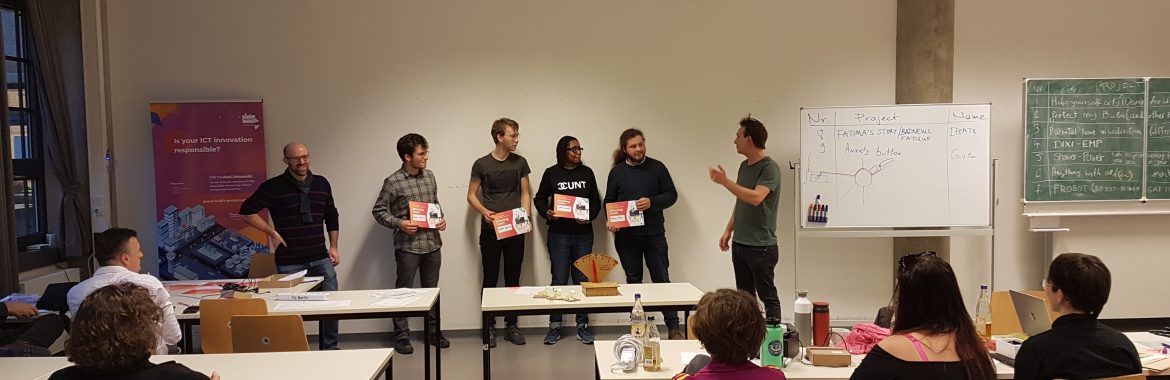
“Mummy’s Little Income Shrinker” wins first HubIT ICT Maker Lab
In the context of the HubIT project (H2020), the first ICT MakerLab was organised in Berlin on 21-23 February 2020. This event aimed at bringing together experts from the fields of SSH and ICT to create concrete digital products with social added value and reflect on the ethical aspects of digital activities.
In total, 19 participants from 6 countries took part in the event. Participants were divided into 5 interdisciplinary teams, which competed during 2,5 days in designing and building ICT prototypes that aimed to raise awareness on or address social issues. The teams could rely on several infrastructures available on site (3D printers, laser cutter, etc….) and were coached by a technical team. They also partook in a self-assessment session where they reflected and discussed in group about their work division and the ethical aspects of their product. Finally, they pitched their ideas to 3 professional experts & judges and had the possibility to showcase their products to the participants during a small maker fair. The winning team from the project called “Mummy’s little income shrinker” developed a weighing machine displaying the evolution of the gender pay gap depending on the number of children a woman has.
This event was the first MakerLab of the working package entitled “practical collaborative events” and under the responsibility of nexus. Further events that aim to bring social scientists and ICT experts to work together on responsible innovations are going to take place on 27-29 March 2020 in Berlin (registrations are open here) and in Budapest in May 2020.
Pedal Consulting is a partner in the HubIT project.
