
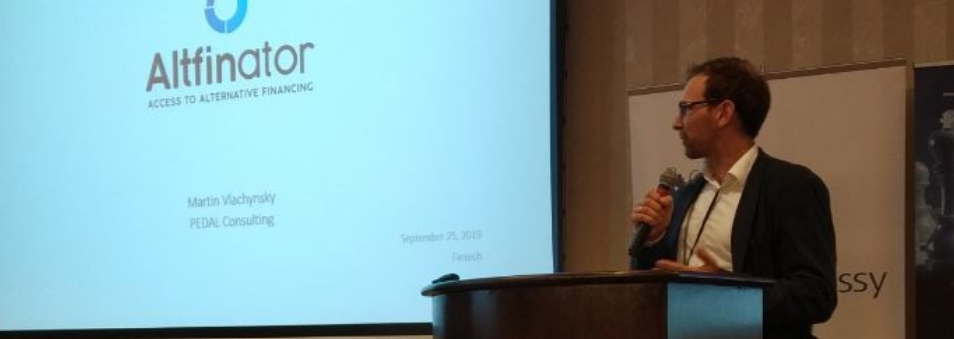
The third edition of the Fin.Techsummit Conference, took place in the capital of Slovakia on September 25, and focused on technological innovation in the financial sector.
The event represented a valuable opportunity for the participants to be engaged in very open and lively debates on the future of finance, which is today significantly affected by new technologies and digitization. The conference addressed the fintech segment that closely blends these areas, as well as the significant role played by the highly innovative, fast-growing technology startups.
Fin.Techsummit already achieved the top international level and prestige with its two-year existence and by affiliate events, it is confirmed by the participation of leading foreign experts. Almost 50 speakers participated, including CEO of Limitless Sara Koslinska, regional manager of SixThirty Ventures Samarth Shekhar, or Maxim Lyadvinsky, an “angel investor” and the founder of the Bloomio crowdfunding platform based in Switzerland.
Altfinator was presented in Stream 1, subtitled “Accelerating digital transformation”, by PEDAL Consultant Martin Vlachynsky, who delivered a presentation focusing on the features of Altfinator portal and project, but also explained the core goals and activities of the project to the audience and invited them to participate in the upcoming MOOC. The presentation was followed by a lively discussion.
Fin.Techsummit was attended by around 150 financial and tech professionals, investors, policymakers, journalist and the general public.
For more information please contact r.miskuf@pedal-consulting.eu

THIRD ISSUE OF ALTFINATOR NEWSLETTER IS OUT NOW!
Altfinator project, where Pedal Consulting is a partner, is funded by the European Union’s Horizon 2020 Research and Innovation programme, constituted by a consortium of 11 experienced partners with deep knowledge in alternative financing, access to risk finance, consulting services, capacity-building, mentoring, gender issues and communication. Its aim is to transfer best practices of alternative financing from more advanced to less advanced markets and bridge the gap in Europe.
Check out the third issue of Altfinator newsletter here.

ENABLING ALTERNATIVE FINACNE ECOSYSTEMS WORKSHOP
Altfinator, where PEDAL Consulting is a partner, would like to invite you to participate in “Enabling Alternative Finance Ecosystems” workshop that will take place at Utrecht University on 14 October 2019 (13h-18h).
The workshop will introduce different enabling factors and conditions that support the development of Alternative Financing ecosystems and define ideas for scenarios where these factors could be applied at national level in other European countries with the aim to develop the financial ecosystem.
This workshop is designed for:
national alternative finance experts
researchers who are active in supporting the alternative financing ecosystem
policy-makers responsible for access to finance and alternative finance support or promotion (incl. ministries)
national regulators responsible for alternative financing policies
national support organisations that promote entrepreneurships and support SMEs regarding their access to finance
Registration is now open HERE.
More information about the event is available on the project website HERE.

HUBIT PROJECT HAS LAUNCHED FOURTH ISSUE OF ITS NEWSLETTER.
HubIT, where PEDAL Consulting is a partner, is a project funded by HORIZON 2020 running from 2017-2020 led by the motto “Technology with and for Society”. Its aim is to create an ecosystem that will encourage interactions between ICT stakeholders and Social Sciences and Humanities researchers that will assure that ICT development takes into account societal needs.
Fourth issue of the HubIT Newsletter is here.

WORKING TOGETHER TO COMBAT YOUTH UNEMPLOYMENT
The official launch of the Youth Employment Magazine is announced on the UN International Day of Friendship. Nearly 200 institutions from 26 European countries implementing projects financed by Iceland, Liechtenstein and Norway unite to share results of their initiatives aimed at combatting youth unemployment in Europe.
Launched on July 30, the Youth Employment Magazine (https://youthemploymentmag.net/) will function as a content resource for all projects implemented under the EEA and Norway Grants Fund for Youth Employment. Its editorial team consists of experts implementing the projects themselves, who are regularly developing materials about the progress and results of each project. The platform is established by the Fund Operator,a consortium of JCP Italy and Ecorys Polska.
The burning question for Europe
According to recent data shown in the Eurostat database[1], approximately 15 million young people aged 20-34 were neither in employment, nor in education and training (NEET) in the EU-28 in 2018. In Italy and Greece, with the highest youth unemployment rate, more than a quarter of young people were out of the labour market. To promote sustainable and quality youth employment in Europe, Iceland, Liechtenstein and Norway launched in 2017 the EEA and Norway Grants Fund for Youth Employment amounting to 60 million euros. The 26 large-scale projects selected to receive funding are now implementing their initiatives that aim to help around 25 000 young people find a job or create new ones.
“Vulnerable youth often fall outside the formal education and training systems as well as the ordinary labour market, and there is a great need for innovative solutions, transfer of good practice and impact studies on which interventions work and which do not. The 26 projects will develop, pilot or adopt almost 100 new approaches, methods and practices, underlining the innovative nature of the Fund for Youth Employment,” quoting Mrs Grethe Haugøy, Senior Sector Officer for Regional Funds and Global Fund for Social Dialogue and Decent Work at the Financial Mechanism Office, the Secretariat of the EEA and Norway Grants.
One platform beyond borders
Compared to other initiatives of the EEA and Norway Grants, the added value of the Fund for Youth Employment is its transnational focus. This is in line with the Europe 2020 strategy and the EU cohesion policy that takes account of the crucial role regions and cross-border cooperation play for smart, sustainable and inclusive growth. Although the range of the Fund is enormous (project consortia bring together 195 entities from various sectors covering their activities in 26 countries), disseminating results at the level of countries where projects are implemented and the flow of information beyond bordersfaces significant challenges. This is the main reason why a common communication platform in the form of an online magazine is created. It is not accidental that the official launch of the “Youth Employment Magazine” falls on the UN International Day of Friendship, since consortia implementing projects remain in harmonised, constant relations with each other, sharing good practices and exchanging experiences.
Local activities, global information
The newly created magazine will aggregate content prepared by all projects: not only news about current achievements and information on their progress, but also longer substantive articles and various multimedia. Furthermore, the constantly updated calendar will allow the audience to follow all events organised by projects across Europe and the Donor States.
“The online magazine will serve as a platform to inspire, connect and raise awareness among young people in Europe and will become an online hub for all the entities involved in the Fund,” said Raquel Torres Prol, Communication Officer for the Fund for Youth Employment at the Financial Mechanism Office, the Secretariat of the EEA and Norway Grants.
About the EEA and Norway Grants Fund for Youth Employment
€60.6 million in funding.
3 donor countries – Iceland, Liechtenstein, Norway.
Supporting 26 transnational projects that promote quality youth employment.
Intends in particular to reach the long-term unemployed in the age group 25-29, to be complementary to existing EU funding.
More information: http://eeagrants.org/fundforyouthemployment.
[1] https://ec.europa.eu/eurostat/web/products-eurostat-news/-/DDN-20190627-1 (accessed in July 2019)

YOUTH IMPACT PROJECT: WHY TO GET INVOLVED?
Youth Impact, partnered by PEDAL Consulting, is an international project focused on capacity development of organisations dedicated to support youth employment and entrepreneurship in the field of impact evaluation.
The project aims to create strategic tools and methods, deliver training and build transnational network of experts in the field of impact evaluation. The participation is free of charge thanks to support from EEA and Norway Grants.
The YOUTH IMPACT project envisions to deliver & test a comprehensive package of practical tools and build a transnational network of organisations interested in impact evaluation. Get involved and increase the impact of your activities with us!
Research: Research on existing evaluation standards & practices regarding youth unemployment
Employment Package: Developing tools for impact evaluation of youth employment support actions
Entrepreneurship Package: Developing tools for impact evaluation of youth entrepreneurship support actions
Training: Testing of impact evaluation packages through workshops & e-learning
Impact Research Network: Developing transnational research network & capacity building of organisations
Research Excellence Programme: Encouraging excellence in impact studies among young researchers
We are looking forward to involve you in the project! For more information, please visit http://www.youth-impact.eu/ or contact r.miskuf@pedal-consulting.eu.

Check out the second issue of BIOVOICES Newsletter!
In the last months BIOVOICES project consortium, where PEDAL Consulting is a partner, has been organising events on bioeconomy all over Europe to create awareness and bring together research, policymakers, business and civil society.
In the second issue of BIOVOICES Newsletter, you can see an overview of all past events, as well as learn about two brand-new online tools: the BIOVOICES Map and the Bioart Gallery!
Moreover, you can read about insights from BIOVOICES consortium and learn about upcoming events. And if you wish so, you can now follow BIOVOICES even on Instagram.
Learn about all of this and more here: biovoices_newsletter#2

PEDAL SECURES ADDITIONAL €1.5M COSME GRANT TO ENLARGE THE PORTFOLIO OF TENDERIO SERVICES
The newly funded project coordinated by PEDAL will design and implement a series of pilot public procurement for innovation (PPI) actions in the area of clean energy and healthcare.
Background and context
Public procurement is a powerful instrument to drive faster adoption of innovation among public sector users while simultaneously promoting economic growth by providing innovative companies the opportunity for first user references. Strategic use of public procurement involves harnessing the purchasing power of public authorities, public service providers and publicly owned utilities to trigger development of new products and solutions and be responsive in adopting innovative supply. By doing so, the public sector can find better solutions to needs currently unsatisfied by conventional solutions to improve efficiency, service quality, sustainability and effectiveness of public services. Simultaneously, innovative firms are provided with opportunities to obtain first customer references for new products and solutions, thus driving growth and economic renewal. The strategic use of procurement to boost demand for innovative goods of services has become an important part of the innovation policy agenda in many EU countries.
Beyond meeting the needs of individual public sector organizations, there is the potential for Public Procurement of Innovation (PPI) to be ‘catalytic’ – i.e., to trigger the purchase of innovative solutions on a larger scale. When procurers represent a critical mass they can help to shift both public and private sector demand towards new technologies and processes. In certain sectors, the demand-pull from the public sector is the most important instrument to develop new markets for innovative products and services.
Key challenges
Despite the significant potential of PPI, the wide spread adoption is only slowly taking up, mainly because of the following challenges:
There are problems of awareness, knowledge, experience and capabilities related to new technologies and market developments
There is a lack of incentives and motivation of buying innovative solutions from a new company rather than buying established products from long-standing suppliers (risk-aversion)
Procurement is often treated as a purely financial and administrative task and so is not aligned with broader policy objectives
Public procurement markets are more fragmented in Europe than elsewhere, making it more difficult to reach critical mass and limiting opportunities for fostering more standardised or interoperable solutions.
There are particular difficulties for innovative SMEs to be involved in public procurement as direct providers to contracting authorities (lack of time, resources, bureaucracy, etc.)
New project
Known under the acronym “PRONTO” (Piloting Public Procurement of Innovation), the project builds on the TENDERIO platform which improves access of SMEs to international public contracts. It addresses the above-mentioned challenges by:
Encouraging cooperation and knowledge sharing between public buyers to promote the use of public procurement to contribute to the development of sustainable innovation, thus creating a fertile platform for future collaboration.
Using public procurement as a mechanism to pilot sustainable innovation in areas of clean energy and healthcare
Linking and establishing synergies with research and innovation projects funded by the EU (via Horizon 2020, COSME or other EU funding programmes), with specific focus on EU funded projects fostering PPI, whenever possible.
The project team consists of three public buyers and seven SMEs, from 8 EU countries.
Notes for editors
PRONTO project will receive funding worth € 1.502.759 from the Programme for Competitiveness of Enterprises and Small and Medium-sized Enterprises (COSME). Interviews and a full demonstration of all the services are available. Please contact: r.miskuf@pedal-consulting.eu

PEDAL secures additional €1.5M COSME grant to enlarge the portfolio of TENDERIO services
The newly funded project coordinated by PEDAL will design and implement a series of pilot public procurement for innovation (PPI) actions in the area of clean energy and healthcare.
Background and context
Public procurement is a powerful instrument to drive faster adoption of innovation among public sector users while simultaneously promoting economic growth by providing innovative companies the opportunity for first user references. Strategic use of public procurement involves harnessing the purchasing power of public authorities, public service providers and publicly owned utilities to trigger development of new products and solutions and be responsive in adopting innovative supply. By doing so, the public sector can find better solutions to needs currently unsatisfied by conventional solutions to improve efficiency, service quality, sustainability and effectiveness of public services. Simultaneously, innovative firms are provided with opportunities to obtain first customer references for new products and solutions, thus driving growth and economic renewal. The strategic use of procurement to boost demand for innovative goods of services has become an important part of the innovation policy agenda in many EU countries.
Beyond meeting the needs of individual public sector organizations, there is the potential for Public Procurement of Innovation (PPI) to be ‘catalytic’ – i.e., to trigger the purchase of innovative solutions on a larger scale. When procurers represent a critical mass they can help to shift both public and private sector demand towards new technologies and processes. In certain sectors, the demand-pull from the public sector is the most important instrument to develop new markets for innovative products and services.
Key challenges
Despite the significant potential of PPI, the wide spread adoption is only slowly taking up, mainly because of the following challenges:
There are problems of awareness, knowledge, experience and capabilities related to new technologies and market developments
There is a lack of incentives and motivation of buying innovative solutions from a new company rather than buying established products from long-standing suppliers (risk-aversion)
Procurement is often treated as a purely financial and administrative task and so is not aligned with broader policy objectives
Public procurement markets are more fragmented in Europe than elsewhere, making it more difficult to reach critical mass and limiting opportunities for fostering more standardised or interoperable solutions.
There are particular difficulties for innovative SMEs to be involved in public procurement as direct providers to contracting authorities (lack of time, resources, bureaucracy, etc.)
New project
Known under the acronym “PRONTO” (Piloting Public Procurement of Innovation), the project builds on the TENDERIO platform which improves access of SMEs to international public contracts. It addresses the above-mentioned challenges by:
Encouraging cooperation and knowledge sharing between public buyers to promote the use of public procurement to contribute to the development of sustainable innovation, thus creating a fertile platform for future collaboration.
Using public procurement as a mechanism to pilot sustainable innovation in areas of clean energy and healthcare
Linking and establishing synergies with research and innovation projects funded by the EU (via Horizon 2020, COSME or other EU funding programmes), with specific focus on EU funded projects fostering PPI, whenever possible.
The project team consists of three public buyers and seven SMEs, from 8 EU countries.
Notes for editors
PRONTO project will receive funding worth € 1.502.759 from the Programme for Competitiveness of Enterprises and Small and Medium-sized Enterprises (COSME). Interviews and a full demonstration of all the services are available. Please contact: r.miskuf@pedal-consulting.eu

SECOND ISSUE OF ALTFINATOR NEWSLETTER IS OUT NOW!
Altfinator project, where Pedal Consulting is a partner, is funded by the European Union’s Horizon 2020 Research and Innovation programme, constituted by a consortium of 11 experienced partners with deep knowledge in alternative financing, access to risk finance, consulting services, capacity-building, mentoring, gender issues and communication. Its aim is to transfer best practices of alternative financing from more advanced to less advanced markets and bridge the gap in Europe.
Check out the second issue of Altfinator magazine to learn more about this ambitious project and the events that have been organised: Altfinator Newsletter 2

PEDAL joins the Slovak Fintech Association
With the objective to increase the impact as well as the sustainability of the Altfinator project, where PEDAL Consulting is a partner, we recently joined the Slovak FinTech Association.
The association was founded in August 2018. Its main goal is to create a platform for effective communication between entities operating in the field of FinTech technologies and regulators, users, professionals and the general public. The association is focused on supporting the establishment and development of Slovak private entities providing financial services related to modern technologies and the Internet. It will set up working groups, conduct open discussions with both governmental and non-governmental sectors, and work with FinTech associations, within the V4 Group and the European Union.
For more information please contact r.miskuf@pedal-consulting.eu

Learn about sustainable future in the Biobridges Newsletter!
Now more than ever, bio-based products, industries and consumers play a crucial role, shaping our future towards greener European economy!
BIOBRIDGES project, where PEDAL Consulting is a partner, was conceived to tackle the key challenge of improving the marketability of bio-based products (BBPs) by fostering close cooperation and partnerships among bio-based industries, brand owners and consumers’ representatives.
Learn more about this project in its first Newsletter. You can find it here: Biobridges_Newsletter #01
